
Panic Attack or Anxiety Attack? One of These Is a Clinical Term and the Other Is Not
Key Takeaways ● Panic attack is a defined clinical event in the DSM-5-TR. Anxiety attack is an everyday phrase with no clinical definition. ● A panic attack is an abrupt surge of fear or discomfort that peaks within minutes, with at least 4 of 13 listed symptoms. ● What people call an anxiety attack usually builds slowly, sits at lower intensity and lasts far longer. ● Most panic attacks fade within 20 to 30 minutes, though the exhausted feeling afterwards can last hours. ● Lifetime prevalence of panic attacks is around 13.2% across countries, according to the World Mental Health Surveys. ● Cognitive behavioural therapy is the first-line psychological treatment for panic disorder. |
One person describes their chest tightening in a supermarket and their vision narrowing, over in fifteen minutes. Another describes a dread that sat on them from Sunday afternoon until Tuesday night. Both say they had an anxiety attack.
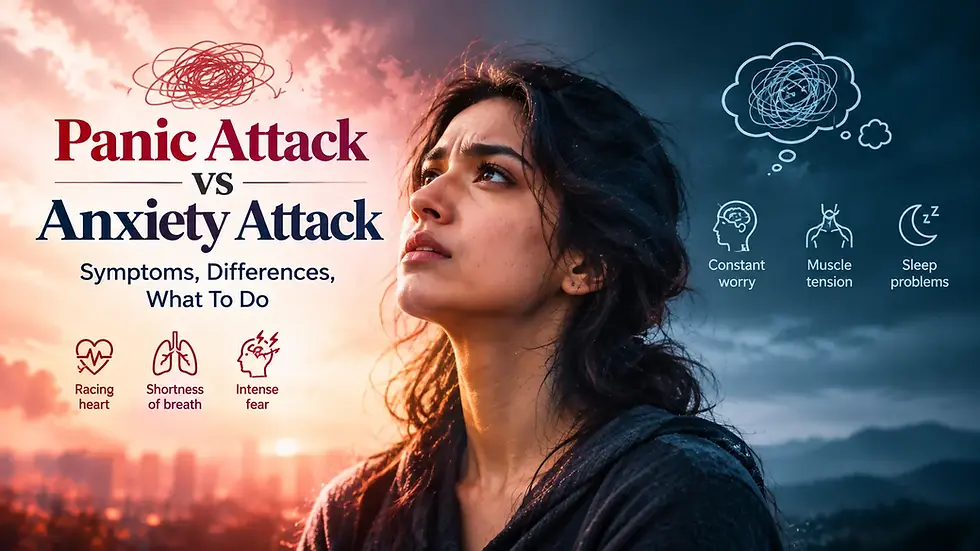
Only one of those has a name a clinician can work with, and knowing which one changes what help you get.
Why only one of these terms is official
The Diagnostic and Statistical Manual of Mental Disorders, Fifth Edition, Text Revision (DSM-5-TR) defines a panic attack precisely. It appears as a specifier attached to other diagnoses, which is why a panic attack is not itself a disorder. You can have one during depression, during PTSD or with no diagnosis at all.
Anxiety attack does not appear in the DSM-5-TR. People reached for it because it names something real that the manual splits across generalised anxiety disorder, situational anxiety and acute stress. The phrase is useful in conversation and useless in a referral letter.
Worth saying plainly, because the two get presented online as equivalent clinical categories. One was built by committee over decades. The other was built by ordinary people trying to describe how they felt.
The DSM-5-TR definition of a panic attack
A panic attack is an abrupt surge of intense fear or intense discomfort that reaches a peak within minutes, during which four or more of the following thirteen symptoms occur. The surge can start from a calm state or an already anxious one.
# | Symptom | # | Symptom |
1 | Palpitations, pounding heart or fast heart rate | 8 | Dizziness, unsteadiness, light-headedness or faintness |
2 | Sweating | 9 | Chills or heat sensations |
3 | Trembling or shaking | 10 | Numbness or tingling |
4 | Shortness of breath or smothering | 11 | Feelings of unreality or detachment from yourself |
5 | Feelings of choking | 12 | Fear of losing control |
6 | Chest pain or discomfort | 13 | Fear of dying |
7 | Nausea or abdominal distress |
|
|
Fewer than four symptoms and clinicians call it a limited-symptom attack, which is still real and unpleasant but below the full threshold.
Note how many of the thirteen are physical rather than emotional. That is why so many first panic attacks end in an emergency department.
What people mean by anxiety attack
Used informally, it describes anxiety that has escalated past the point of being manageable, without the abrupt spike of panic. The build is slow and usually traceable to something identifiable: a deadline, an exam, a conversation you have been avoiding.
Symptoms overlap heavily with panic: tight chest, restlessness, nausea, racing thoughts, poor sleep. What differs is the shape of the curve. Panic spikes and falls. This plateaus and stays.
Side by side
| Panic attack | What people call an anxiety attack |
Clinical status | Defined in DSM-5-TR | Not a clinical term |
Onset | Abrupt, often with no trigger | Gradual, usually with a trigger |
Time to peak | Within minutes | May never peak, plateaus instead |
Intensity | Severe, overwhelming | Mild to severe |
Typical duration | 20 to 30 minutes | Hours, days or longer |
Physical symptoms | Dominant and alarming | Present but usually milder |
Fear present | Of dying, collapsing or losing control | Of a specific anticipated outcome |
Afterwards | Drained, shaky, often fearful of the next one | Worry continues at a lower level |
How common is this
Panic attacks are far more common than panic disorder. The World Mental Health Surveys, a cross-national study, put lifetime prevalence of panic attacks at around 13.2%. Most of those people never develop a disorder.
Panic disorder is diagnosed when attacks recur unexpectedly and are followed by persistent worry about further attacks, or by behaviour changes designed to avoid them. US figures from the National Institute of Mental Health:
Measure | Figure |
Past-year prevalence among US adults | 2.7% |
Lifetime prevalence among US adults | 4.7% |
Past-year prevalence, women | 3.8% |
Past-year prevalence, men | 1.6% |
Average age of onset | 24 years |
When to treat it as a medical emergency
Chest pain, breathlessness and a pounding heart belong to both panic and several cardiac and respiratory conditions. No article can tell you which you are having, and nobody should have to make that call alone.
Seek emergency medical help rather than assuming panic if any of the following apply.
● This is your first episode of chest pain and you have no diagnosis of panic
● The pain is crushing or pressing, or spreads to the arm, jaw, neck or back
● You faint or nearly faint
● You have known heart disease, high blood pressure or diabetes
● Breathlessness continues after the fear has passed
● Symptoms came on during physical exertion
Being checked and told it was panic is a good outcome, and it is how many people get their diagnosis in the first place.
What helps during an attack
The instinct is to fight it, and fighting it reliably makes it worse. These work by lowering the alarm rather than stopping the surge, because the surge stops by itself.
1. Sit down somewhere you feel safe. Standing adds light-headedness to everything else.
2. Lengthen the out-breath. Breathe in for about four counts and out for about six. The slow exhale is the part that matters, not deep breathing, which can make it worse.
3. Name what is around you. Five things you can see, four you can hear, three you can touch. Concrete input instead of catastrophic prediction.
4. Tell yourself what is happening. "This is a panic attack. It peaks and falls. It has never not stopped."
5. Stay where you are if you can. Leaving teaches the brain the place was the danger, which is how avoidance starts.
6. Expect to feel wrung out afterwards. A few hours of tiredness, shakiness or a dull headache is normal and is not a sign it is returning.
Treatment that has evidence behind it
Cognitive behavioural therapy is the first-line psychological treatment for panic disorder. The panic-specific version targets the catastrophic interpretation ("my heart is racing so I am dying") and the avoidance that quietly shrinks a person's life. Interoceptive exposure, deliberately bringing on the physical sensations in a controlled setting, is often part of it.
SSRI antidepressants are commonly prescribed, alone or alongside therapy, and a doctor will weigh severity, history and preference in deciding. Benzodiazepines are sometimes used short term and come with dependence risks that make them a poor long-term answer.
For anxiety that builds rather than spikes, treatment targets the underlying pattern instead of the episodes, so therapy, sleep, exercise and cutting alcohol and caffeine carry more weight than in-the-moment techniques.
Myths vs Facts
Myth | Fact |
Anxiety attacks and panic attacks are two official diagnoses | Only panic attack is defined clinically. Anxiety attack is a colloquial term |
A panic attack can kill you | Panic attacks are not physically dangerous. The symptoms are alarming because they mimic conditions that are |
You can faint from a panic attack | Fainting is uncommon, because blood pressure usually rises during panic rather than dropping |
Panic attacks always have a trigger | The DSM-5-TR explicitly allows unexpected attacks that begin from a calm state |
Breathing into a paper bag is the standard fix | This is no longer recommended and can be dangerous if the cause turns out to be cardiac or respiratory |
You will have them forever once they start | Panic disorder responds well to treatment. Many people stop having attacks entirely |
Frequently Asked Questions
What is the main difference between a panic attack and an anxiety attack?
A panic attack is a defined clinical event: an abrupt surge peaking within minutes with four or more of thirteen symptoms. Anxiety attack is an everyday phrase for anxiety that builds gradually and persists at lower intensity.
How long does a panic attack last?
Symptoms peak within minutes and most attacks subside within 20 to 30 minutes. Feeling drained or on edge for several hours afterwards is normal and is not the attack continuing.
Can a panic attack feel like a heart attack?
Yes, which is why panic is a common reason for emergency visits. If this is a first episode of chest pain, or the pain is crushing, spreads to the arm or jaw, or comes with fainting, get emergency help rather than assuming panic.
How common are panic attacks?
The World Mental Health Surveys put lifetime prevalence of panic attacks at around 13.2%. Panic disorder, the recurrent form, affects about 2.7% of US adults in a given year according to NIMH.
What should I do during a panic attack?
Sit down, make each out-breath longer than the in-breath, name concrete things around you and remind yourself the surge peaks and falls on its own. Stop trying to force it to stop.
What treatment works for panic attacks?
Cognitive behavioural therapy is first-line and well evidenced. SSRIs are commonly used alongside or instead, depending on severity. A GP or doctor is the right place to start that decision.
Disclaimer: This article is for general information and education and is not medical advice, diagnosis or treatment. Chest pain and breathlessness can have serious physical causes, so seek urgent medical assessment rather than self-diagnosing. If panic or anxiety is affecting your daily life, speak to a GP or a qualified mental health professional, and if you are in crisis contact your local emergency number or a crisis helpline.


Comments